Female Fundraising Charity Auctioneers
  • HOME
  • Services
  • Videos
  • ABOUT
    • Press
  • Testimonials
  • RESOURCES
  • Freebies
  • Contact
  • New Page

Prioritizing the Fund-A-Need at Your Nonprofit Event

2/24/2020

0 Comments

 
Picture
I tend to get pushback from my clients when I suggest moving the Fund-A-Need to the beginning of the event program. And I totally get it. Fund-A-Needs are traditionally done following the live auction. Moving the Fund-A-Need is taking a risk. Risks are scary. Change is scary. However, as I’ve discussed before, moving the Fund-A-Need to the beginning of the program has the potential to help your nonprofit capture every last dollar in the room.

I want to walk you through a recent conversation I had with a client because I want you to feel comfortable taking this risk at your next fundraising event.

Historically, nonprofits and other organizations, at the end of their large charity galas, would make a general call for donations. This was designed to invite anyone to give who hadn’t participated in the live auction or who wasn’t a major donor. Over time this became more nuanced and morphed into the Fund-A-Need as we know it today, but it has always stayed at the end of the auction. People are comfortable with this because it has always been done this way. Nonprofits carry on, using the live auction as a warm-up to the Fund-A-Need, unaware of how much better their Fund-A-Need could do if it kicked off the evening.

For a long time, I agreed with this positioning. I thought the Fund-A-Need worked best at the end because that’s where it has always been.

But I was wrong.

Having the Fund-A-Need in its traditional spot means that your guests, most of whom are not participating in the live auction, have to sit there politely, trying not to get bored, as a small percentage of the room participates in the auction portion of the evening. If your nonprofit has a particularly lengthy live auction, let’s say thirty or forty lots, this can easily take an hour or two. Now, I’m an auctioneer and even I find listening to bid calls for that long absolutely mind-numbing. What happens if most of the room is sitting there bored out of their minds for an hour or two? Their motivation to give dies. 

Does this mean you should never put your Fund-A-Need after your live auction? Of course not! Personally, I will do the Fund-A-Need after the live auction if we have five lots or less. That’s just the right number of items to allow you to get through the live auction before you lose the room.

To figure out where the Fund-A-Need should go in your program, go back and look at your old show flows. Where did the Fund-A-Need fall? What time was it slotted for? Then, look up your participation percentage, and the number of auction items.

If you have more than twelve auction items, you should consider doing your Fund-A-Need first. 

If your participation percentage is under thirty percent, you should consider doing your Fund-A-Need first. 

If you have done your Fund-A-Need after 10 p.m for three or more consecutive years, you should consider doing your Fund-A-Need first.

If your event is on a weeknight, in a major city, you should consider doing your Fund-A-Need first.

Now, when I say first, I don’t mean first thing after people get to their seats. I mean that you should do your Fund-A-Need before the live auction, because the live auction is usually the longest part of the evening. There are many factors that encourage your guests to give, but there are many more factors that discourage giving. Boredom and time are the two factors most likely to discourage giving, so you want to eliminate those from the equation as much as possible.

We can mitigate boredom by not forcing the room to sit through a live auction that only a handful of people will participate in.

But what do I mean by “time?”

Towards the end of your event, there will come a time when couples start to filter out because they are tired, they want to avoid traffic, or they have to get home to relieve the babysitter. It’s inevitable. It happens at nearly every event I do. At one event I did, I literally watched half the room get up at 10 p.m. and walk out the door. At another, we had a three-hour dinner and then, after dessert was served, we started the auction. It was 9:30 p.m. Who’s going to sit around for that? People who want to buy something at the auction, sure, but no one else. 

Moving your Fund-A-Need to the beginning of the program helps reduce the effects of both boredom and time. 

Fund-A-Need success requires participation from as many people as possible. To achieve this, I coach my clients to move the Fund-A-Need to the beginning of the event and we are getting great results. 

If the idea of moving the Fund-A-Need complicates your usual program, here’s one way you could consider setting up the evening:
  1. Cocktail hour with a raffle or silent auction
  2. A speech from a board member or the event chair
  3. Give out an award if you have one
  4. Bring out the CEO for a speech
  5. Show a short video
  6. Bring out your speaker and launch into the Fund-A-Need
  7. Dinner
  8. Live auction
  9. Any other speeches or awards   

At the end of the day, I think a more productive Fund-A-Need is worth switching up the usual fundraising event program. With an engaging charity auctioneer and a room motivated to give, your Fund-A-Need can smash past fundraising records.
0 Comments

Inside My Business: Secrets to Sealing the Deal

2/17/2020

0 Comments

 
Picture
I won’t lie. 

I’m a good auctioneer.

I’m a rockstar at Fund-A-Need auctions.

I’m a fundraising ace.

I’m also a top-notch sales woman.

Did you just get the heebie jeebies? 

Many people hate sales, but not me. Today, I want to share my secrets for a successful initial client call. Over the years I have developed a method for conducting these calls that helps me land the jobs I want, ninety percent of the time. 

This initial call is part informational and 100% a sales call. These forty-five minutes are how we make the choice to work together.

People get in touch with me in all sorts of ways, but most often they reach out through a form on my website. Each time this form is filled out, I get an email with the person’s contact information.

As soon as I can, I take some time to look up the organization. I’m looking for a couple things here: who they are, what they do, and whether I can get behind their message. I only proceed with nonprofits whose mission I can get behind. If the nonprofit’s mission is something I cannot connect with, I politely decline.

I also spend some time researching the nonprofit’s past events. I’ll look at pictures and read over any information available about the event. I’m looking for details here. Seating arrangements, how people are dressed, major philanthropists in attendance, the timing of the event. But most importantly, I’m looking to see if people are paying attention. All these seemingly minor details can give me a ton of information about an event before we even hop on the phone. 

At this point, my trusty assistant emails the organization with links to schedule a call and download a worksheet. The worksheet asks questions about the nonprofit’s most recent Fund-A-Need event so that I can better gauge how much room for growth the event has.

When it’s time for our chat, here’s how it typically goes
We hop on the call and jump right into a discussion of the upcoming event. Because I do my research ahead of time, there’s no need to spend time explaining the story of the nonprofit, their mission, and their past events. I’m maximizing time here by getting straight to the stuff that counts. Also, I’m beginning the process of building trust, based on the fact that I took the time to do my research.

I’ll ask for information on the upcoming event, typically based on data from previous years.
  • How many people?
  • How many revenue streams?
  • What kind of revenue streams?
  • Have you used a professional auctioneer before? If so, who?

These questions help me understand a few things:
  1. Does the nonprofit know what it needs and what it wants from this event? Hint: Often, these are two different things.
  2. Are they clear on why they haven’t been reaching their fundraising goals?

Then, we go over the worksheet and talk about what can be expected from the event, in terms of REAL fundraising growth.

My secret to winning all the clients I want is honestly.

I am always honest when giving advice on how to increase fundraising at events. If there is money left in the room, as oftentimes there is, I’ll say so. But, if the nonprofit in question is already achieving 70-80% participation during the Fund-A-Need, then I’m very honest about how we need to set realistic expectations in terms of fundraising. There’s just not a ton of money left in a room with that kind of participation.

At this point of the call, the client usually asks a ton of questions about how I work, how much I cost, what’s included, etc. 

But what I think is most important is how I end the call. I talk a lot about feelings. 

The nonprofit world is filled with women. As a woman, as a mom, as a former nonprofit employee, I talk about how I want to feel about the working relationship. Fundraising is a touchy-feely business. Donors give because of how we make them feel. How people feel is important. 

Coming off of that first call I want my clients to feel like they can trust me, more than any other auctioneer, to do what’s best for them. To achieve this, I always tell potential clients exactly what I think. If they have a question, I give them the answer for free. I won’t give them step-by-step instructions, but I’ll tell them the solution to their problem and make a few recommendations. 

Many auctioneers guard their secrets, but I don’t. I know a very well-known auctioneer who starts all of his calls by asking his clients to tell him about their organization. When you’re on the phone with me, the entire call is spent on your event. I want to take the time to really dig deep and see if I can help, because sometimes I can’t. Some people advertise a free consultation, but what that really means is you’ll explain your organization and event and the auctioneer will give you a sales pitch. 

I really do provide a free consultation because my main goal is not to sell you on my service, I want to help you raise more money. I want to help you make the world a better place. For me, it’s about helping the organization first.

My business model is based on transparency. I want all nonprofits to succeed, even if they can’t afford me. You can find all of my secrets online for free, if you look. I am often on the phone answering questions and talking about fundraising longer with nonprofits who can’t afford to hire me, because I believe in the work.

I recently spoke to a client who was looking to increase their fundraising at their yearly gala. The way this event is structured, it functions more as a very expensive promotional event than a fundraiser. 

They have a handful of speakers, a couple of honorees, auctions, and a Fund-A-Need to round out the evening. Their event is in NYC, on a Tuesday night. Most of their donors have to get up for work in the morning, so there’s no guaranteeing they’re going to stay long enough to even see the Fund-A-Need. 

I suggested very plainly that they move the Fund-A-Need up in the program, placing it right after their opening speaker. This way, I’ve got the money early and it doesn’t matter what time people leave.

The event is a couple months away (at the time of writing) and I think they’ll be pleasantly surprised by what we’re able to accomplish with this single change.
0 Comments

Three Questions Your Charity Auctioneer Should Ask Before Your Auction

2/10/2020

0 Comments

 
Picture
Clients don’t often get angry with me because of something to do with their auction. I do my best to be open and honest through the entire planning process in order to avoid such situations. 

The only time a client did get upset with me, specifically because of the auction, was the time I did not ask these three questions.

1. Can I double this item? If so, what is the minimum I can double it for?

After the client gives me a number, let’s say it’s $3000, I will rephrase the question and ask it again. “To be clear, if I have one bidder at $2700 and one at $2800 you don’t want me to sell two and make you $5500? You only want me to double it if I can get $3000 for each?

I ask this question twice because this is not a call that I, or any good auctioneer, can make on the fly. It leaves too much room for discrepancy. No auctioneer should be expected to make a call on the fly about how much you can and can’t sell an item for. 

2. Does this item have a minimum selling price? 

There are costs built-in to any event and there’s an amount the auction must make just to recoup the costs associated with it. I need to know the minimum price for each item so I don’t go below that price and jeopardize the income of the event.

3. Does this item have a minimum starting bid? 

I didn’t always ask this question because, as an auctioneer, I really prefer to set my own starting bids. I can adjust them up or down depending on how well the auction is going, how the energy in the room is working, etc. 

If a donor gives an item to an auction with the stipulation that the bidding cannot start lower than a certain amount, it’s important for me to know what that amount is. I can then adjust the order of the auction items, if necessary. If a donor stipulates that the starting bid on his item must be $2000, for example, I’ll move that item to later in the auction. You just can’t start most successful auctions with a $2000 opening bid. 

Most people who aren’t in the industry assume that if you start high, you end high, but that’s not the case. When you start low, you end high because more people are able to participate, which builds the momentum and pushes the bids higher and higher. When items don’t sell well at my auctions, it is usually because the opening bid was set by someone else and it was high. 

This is why I encourage nonprofits not to let their donors set the starting bids.

I did a school auction not long ago, and two of the donors were very concerned with how we packaged their items. One was specifically concerned that her item would have no bids unless we bundled it with something else. I offered to talk to the two donors on the phone and explain why their items were being packaged the way they were. 

It turned out that their previous experience donating items to the school auction had not been pleasant. The previous auctioneer had not promoted and sold their items in a way that felt good to them, partly because he didn’t know enough about the items. They did not want to be embarrassed if their items didn’t sell again this year. 

They didn’t need to worry. We smashed their fundraising goal and both items sold for way more than they thought possible. 

In the nonprofit world it’s always a game of who is in charge. My job is to help the donor make the right choice, because they are in charge in this moment. They need to make the right choice in order for the item to be successful at auction, it’s my job as the charity auctioneer to lead them down the path to that choice.

I’m happy to report that these donors had a lovely experience and have already committed to donating again this year.          
0 Comments

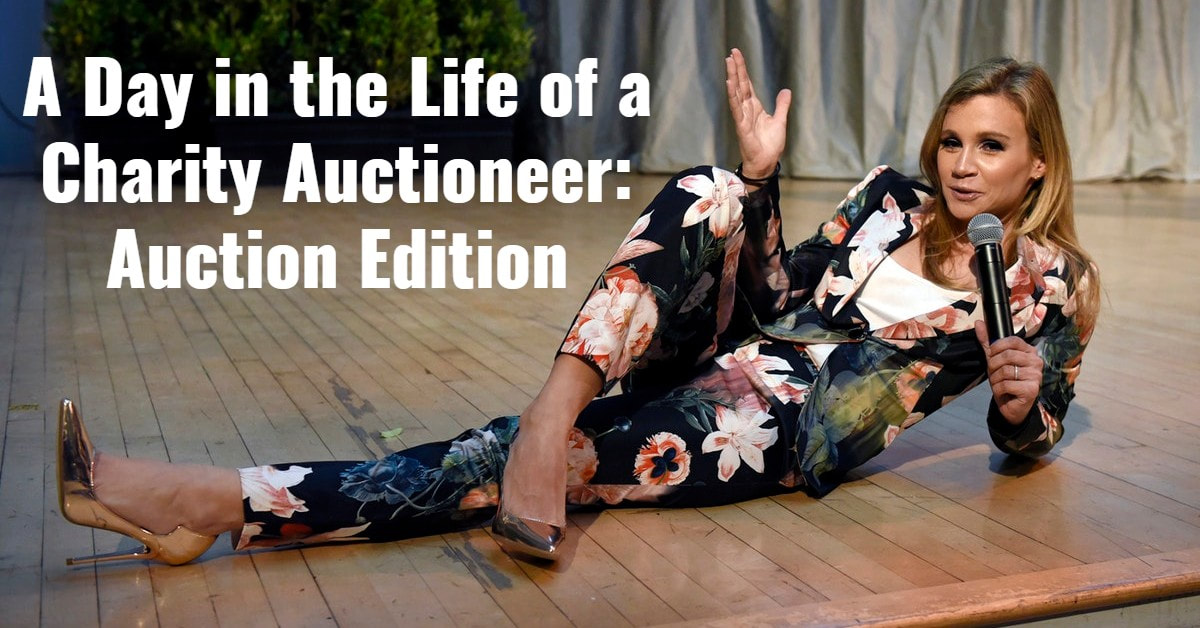
A Day in the Life of a Charity Auctioneer: Auction Edition

2/3/2020

0 Comments

 
Picture
A while ago, I showed you what a typical work day is like for me. If I’m working an auction, my day looks quite a bit different.

Most fundraising events take place in the evening, so I typically start my auction days at noon.
As a female auctioneer, I need more prep time than the men in my field. Sad, but true. So, I start early to make sure there’s time to get everything done properly.

I start with a shower, then I settle in to blow dry my hair. And I mean settle in. I like to blow dry my hair while sitting on the floor and reading a book. This means it takes me a bit longer to blow dry my hair than the average person, but it’s worth it. 

Next, I consult my trusty charity auctioneer outfit spreadsheet. That’s right, I keep track of the outfits I wear to each event, each year. I only see most of the people at these events once a year, and the sad fact is that if I show up in the same outfit twice in a row, I will get comments.

Once I have chosen an outfit for the event, I pack it away in my garment bag and pack my auction bag.

Makeup comes next, but I don’t do it all before I leave the house. I do my skincare routine and put on foundation, everything else waits until I’m at the venue. My foundation looks best if it has time to sink into my skin before I do anything else. So, while it does that, I drive over to the venue. 

Depending on how far I’m driving, I’m in the car between 2:00 p.m. and 2:30 p.m. I always stop for an energy drink on the way. I sip on it slowly on my way to the venue, usually only getting through a quarter of the can before I throw it away. 

The first thing I do when I get to the venue is find my contact. If I can’t find them, I go straight to the sound booth to introduce myself. The sound crew is my backbone. If I don’t have good audio, the auction will sink like a rock. I get a sound check as soon as I possibly can. 

Once the sound check is over, I head to the green room or whatever behind the scenes space they have set aside for the event. I get changed into my auction outfit and do the rest of my makeup.

At about 5:00 p.m. I have a final meeting with the Development Director. Ostensibly this is so they can make sure I have everything I need, but usually it’s the other way around. Then I wait for the auction to begin.

Some of my clients want me out on the floor schmoozing with the guests during the cocktail hour, some of them want me to rehearse with their Fund-A-Need speaker. I fill this pre-auction time with whatever small tasks the nonprofit needs me to do. 

Sometime between 8:00 p.m. and 9:30 p.m. I take to the stage to do the Fund-A-Need and live auction. Afterwards, I meet with the auction recorders and go through my post-auction routine. Sometimes I will hang around to observe the rest of the event, especially if the crowd is particularly energized. Otherwise, I slip into my sweatpants and walk out the door. The funny thing about dressing the way I do for auctions is that as soon as I take my bright, shimmery outfits off, I become invisible. No one remembers what I look like and I can slip out of the building undetected, and before the valet station gets busy. 

Then I drive home, probably stopping at McDonald's on the way. And that’s it, that’s a day in my life if I have an auction in the evening. 

Are you a charity auctioneer or nonprofit professional? What does your event day look like? Let me know in the comments.   
0 Comments

    Archives

    August 2023
    March 2020
    February 2020
    January 2020
    December 2019
    November 2019
    October 2019
    September 2019
    August 2019
    July 2019
    June 2019
    May 2019
    May 2018
    April 2018
    March 2018
    February 2018
    January 2018
    July 2017
    June 2017
    May 2017
    April 2017
    March 2017
    February 2017
    January 2017
    December 2016
    November 2016
    October 2016
    September 2016
    August 2016
    July 2016
    June 2016
    May 2016
    April 2016

    Categories

    All
    Boards And Committees
    Client Testimonials
    Corporate Sponsorship
    Donor Outreach And Appreciation
    Fund A Need Auctions
    Fund-A-Need Auctions
    Fundraising Ideas
    Fundraising Personal Blog
    Fundraising - Personal Blog
    In My Opinion
    Inside My Business
    Live Auctions
    Nonprofit Strategy
    Online Auctions
    Q&A With A Charity Auctioneer
    Raffles
    School Auctions
    Silent Auctions
    Volunteers

    RSS Feed